Showing posts with label Georgia coastal birding. Show all posts

Friday, October 16, 2015

Banding on Jekyll Island

On October 14, I visited Jekyll Island Banding Station (JIBS).  JIBS has been around since the late 1970’s. The data that they gather has been invaluable to understand how migratory bird use Jekyll Island.  Over the years, the data show that the south end of Jekyll is so important to birds traveling along the coast. It offers food, water, and shelter for these birds. Palm Warblers, Common Yellowthroats, American Redstarts and Black-throated Blue Warblers are the main warblers that use this area in late September, but there are always surprises. Plus every year is different. 
 There were Tree Swallows swarming around the wax myrtles then dropping near the swallow water pools.


On the path to the station there were Western Palm Warblers feeding in the grasses.


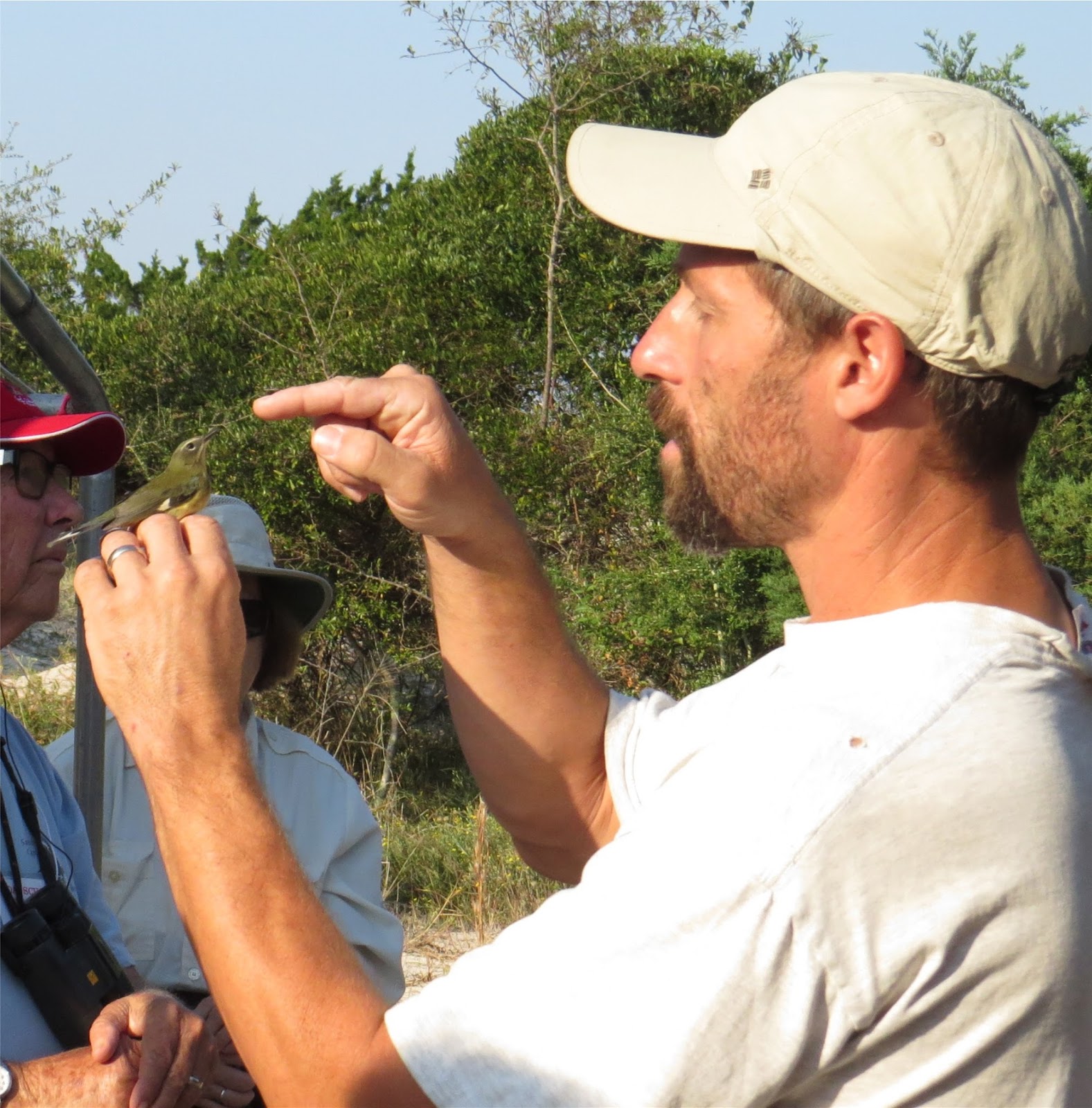
I got to the station, and there was a Road Scholars Group listening to Charlie Muise was showing them some of the birds banded at the station. Here he is with a Blue-throated Blue Warbler female. He is a wealth of knowledge. I know these eager birders learned a lot about birds.
But these Road Scholar got another lesson when the folks studying snakes for the Georgia Sea Turtle Center.  They were very willing to add to the experience of this group. This habitat is important to a wide range of creatures and each creature is important in the habitat. 

Evan Pitman is the Master bander at the station. Here he is working with a Common Ground Dove.
Here is Evan is working with a Bay-breasted Warbler. This is a common bird at the station.
Heather Pitman is holding the Bay-breasted Warblers for record photos.

Meghan Davies is an Americorps Intern at the Georgia Sea Turtle Center and on her days off she likes to go birding. She helped me with some plover work this summer. I told her about the station and she volunteered. She can now add this to her resume.
What fun to see this station continuing to add to our knowledge of this area.


Saturday, April 18, 2015

Plover Patrol at Georgia Sea Turtle Center

The Georgia Sea Turtle Center attracts over 100,000 people to come to Jekyll annually. On Thursday April 9 and Friday, April 10 around 1200 people came to their spring event called Shell-a-brate.
For the past few years, I have had the Operation Plover Patrol booth at this event.  The idea is to teach visitors to the beach about the birds those birds on the beach. This year, we did something different. 
This year we decided to create signs for the nesting shorebirds on our coast. Painting is fun and a good way to engage the public in helping these birds. It wasn’t my idea. I took the idea from Walker Golder, the North Carolina Audubon Director. Since we were on Jekyll and we have a rope line at the south end with nesting Wilson’s Plover, we focus on Wilson’s Plovers.

We talked about why the rope line was up.  We showed pictures of Wilson’s Plovers as family groups. One of those pictures showed the adult in plain sight and the chick blended into the wrack and vegetation. We ask people to find the chicks. It was fun to watch them search and find the chicks.


We had decided to have three slogans to build their sign designs around. Those slogans were “Help the Wilson’s”, “Share the Beach,” and “Protect our nests.”  I had a simple way to draw a bird to show our young artists. 


The young people were very amazing at coming up with ideas on their own. Here are a few of the signs.

Thursday, December 22, 2011

Birder's Eye View, A book review

Just in time for the Holidays, my friend, Diana Churchill has come out with a wonderful book. Diana has been writing a birding column “Birder’s Eye View” for the Savannah newspaper for years. She has taken some of her best columns and put them into a book. It is titled Birder’s Eye View, Savannah & The Low Country.
But wait it isn’t just a collection of stories about birds. She has put a lot of thought into why birds are here along the Georgia coast. Diana has included a section on habitats. She also includes a resource section for those who want to visit the area and needs some tips. The habitat descriptions and resource guide makes this book an invaluable reference guides for the visitors who wants to explore our coast.
The book is divided into seasons and then by months. Each month has a few charming vignettes of the birds you might find in those months. She adds a section on the backyard for those who want to attract birds to yard. You can meet Diana and see her book at Wild Birds Unlimited in Savannah. I am excited to see this delightful book on the shelves at Wild Birds Unlimited Nature Shop at Jekyll Island just in time for the holidays. Check it out!

Sunday, March 13, 2011

Will They nest this year?

The Roseate Spoonbills are back at the Amphitheater Pond. They appear to be adults. Will they nest here this year?

Tuesday, January 25, 2011

Day two; Water bird count & sparrow hunt

Day two intense birding continues:
The Sunday evening I got home just in time. My friend Paul Lehman was coming into town. He was on a ticking mission. What is a ticking mission? Well, Bird Ticking is a game birders play. The idea is to get at least 50% of the birds possible in each of fifty state and the Canadian Provinces. It means you get to know the birds well and see the habitat. Paul goal here was the Common Eider, Long-tailed Duck, Buff-bellied Hummingbird, and Harris's Sparrow.
Paul & I met many years ago when I lived on the road. He was traveling too so we often ran into each other. Over the years, I have camped at his home. Now, I was returning the favor.

Monday Morning, we were at the Harris's Sparrow field at first light. The Altamaha Waterfowl Management Area just south of Darien, GA is managed for wildlife. There are lots of grassy field with great seed crops for wildlife. The sparrows are plentiful. Do you want to really get to know your sparrows? Well this is the place. There are Savannah Sparrows, Song Sparrows, Field Sparrows. Early we both got a glimpse of the Harris Sparrow but it quickly disappeared into the thick brush. Paul got several more glimpses. While we look he talked about where this sparrow might be found in the field. Knowing where to look is half the game. At one point, I flushed a Barn Owl. It was a beautiful owl.

I had the Winter Waterbird Survey. We had to leave. This year, the count was combined with the Piping Plover count. U.S. Fish & Wildlife joins forces with Canada and Caribbean countries to count Piping Plovers. There were birders on the beaches from South Carolina, Georgia and Florida all at the same time counting birds at the same time. This is a great snapshot of the number of shorebirds, sea ducks and sea birds there.
So at 10 a.m. We met Chris Cappola and drove over to Sea Island, a private island. Bill Flatau had a beach vehicle. Paul went looking for the large raft of scaup (ducks.) We head south to survey. We did find one Piping Plover and a lot of shorebirds. Paul called to tell us he had the ducks including the rare ones. We were counting so it took us a little time to get to 27th Street. We were not too late. The raft of ducks were over 3000 strong.
I have a counter so I took on the task of counting the entire raft. Bill and Chris started looking for the Common Eider and Long-tailed Duck. They were found and we all got looks. Still that many ducks was a stunning sight.
Still we could not linger. We were on the count so we headed up at the northern end of Sea Island. There were more shorebirds. Yes, I was in my element. By the time we finished it was a little after 2 p.m. Lunch and a quick look at Gould's Inlet and we were headed back to the sparrow fields.
Gene Keferl joined us and we looked and we looked. We looked at a lot of sparrows but none of them were the Harris's Sparrow. Paul did find a Lincoln Sparrow. After the frustration of the Harris's Sparrow the Lincoln Sparrow was a good end to the day. At the end of two day of intense counting I saw 94 species of birds. Not bad, I also saw pine lands, wetlands, weedy fields, beach and ocean and a lot of wonderful birds.

Friday, September 24, 2010

Georgia Coast Birding and Nature Festival Headquarters

Some breaking news on the Georgia Coast Birding & Nature Festival . We are going to be headquarter at Villa Ospo! It is the perfect setting for the family friendly birding and nature festival. There is lots of parking and green grass. Plus there are a few butterfly areas and great views of Jekyll Creek. For more information on the festival take a look at the website: Georgia Coast Birding and Nature Festival.

Friday, July 16, 2010

Birdy Friday Report

Oh it just not as much fun with out photos but today was a wonderful bird day on Jekyll. Yes, it is very hot and humid out there. First, I was sitting on bench in the shade looking up thinking I sure would like to see a Yellow-throated Warbler and a Yellow-throated Warbler flew in. It didn't stay long but what a pretty bird. I did have the pleasure of the company JR and his dad for a short Amble. JR and his group won his division of the Youth birding team competition last April. It is a pleasure to be in the company of a young talent. His Raven 8x32 Binoculars were perfect for his hands. He got a life bird. There was a Gull-billed Tern working the river. At the campground where we saw Painted Buntings, Ruby-throated Hummingbirds, and North Parula.

They left and I have been in the Wild Birds Unlimited Store. All day a female hummingbird has been looking for food all around the shops gardens. It would be feeding on tiny flower and people would walk right by.

Gene Keferl just stopped by and reported that the Wilson's Plovers are doing ok at the south end. He saw two chicks and three adults. He also reported lots of Royal Terns, Laughing Gulls and skimmers. There were also a few Least Terns.

It is just a birdy Friday

Saturday, December 19, 2009

beach stuff

Monday was so much fun. It was foggy so it was hard to see the rafts of ducks out on the oceans. Instead we looked at our feet. Here is a small collection of beach stuff we saw. The tiny shell in the top middle is a dwarf surf clam. I was told that Red Knots eat these. There were Red Knots present. But I do not know what this is in Hallie's hand. Can anyone tell me? Thanks

Wednesday, August 12, 2009

Here is looking at you


Last Thursday, I spent a little time at the Jekyll Island Campground Bird Sanctuary. We enjoyed watching the chickadees and titmice. But when a Summer Tanager caught a wasp in front of us then processed to eat it, we were captivated.

Sorry the picture is blurry but she was really beating that wasp.


We were able to watch a Yellow Warbler trying to work up the courage to come to the water drip. I could not a photograph for this little bird was in the shadows. But when she would land on a branch in a little bit of sunlight, oh my the yellow just shined.


Of course, the star was this Yellow-throated Warbler that spent some time looking at us. At one point there were two of them chasing each other.

Friday, August 7, 2009

Purple Passion Flower Patch

I need to catch up with all I have been doing. I am trying to broaden my understanding about our complex world. I received an email from a friend about my July 25 butterfly trip to Harris Neck. The email said the passion flower patch was the place for the butterflies. Doesn’t passion flower patch sound wonderful especially when you see one passion flower like this picture taken by Fitz Clarke .
Then you think about a whole patch of purple passion flowers.
Now add a beautiful and flashy butterfly like this Pipevine Swallowtail.

Wow, the colors seem to stand out.
My favorite butterfly is the black and yellow Zebra Heliconius. Passion flower is its host plant. We found eight Zebra Heliconius around lantana that day. Black, yellow and purple are stunning together. We all brought out our cameras and clicked away. Why are we drawn to these black and yellow butterflies and purple flowers?

Orange, yellow and purple are called complimentary colors in the artist's world. We create whole images around complimentary color schemes.
I am amazed at nature with all of its complex designs. This Sleepy Orange is in the purple flowers near the purple passion flower patch. There is so much to see and to learn.

Friday, July 24, 2009

In the pink

Well, it has been a long haul. All the calling, emailing, talking we did to get all the field trips lined up along with the seminars and workshops but the Georgia's Colonial Coast Birding and Nature Festival booklet is at the printers and I am in the pink for the weekend. In celebration I thought I would show some of the pink things I watched today. I was coming back from Jekyll Island. There is a long traffic light while sitting there I look over and this is what I saw.

Can you blame me for pulling off and admiring them?
On the way out to the south end of Jekyll I stop to photograph these Little Pinks. I just held up my little point and shoot and fired away. I am an artist to the core. I didn't care about sharpness of the shots. I wanted to show off how these delicate flowers bring a softness to the hot, harsh environment of the dunes.

Tuesday, July 21, 2009

Exploring the Indian Mound Golf Course

Last Wednesday, I went out at 8:30 am to do some research for the Golf Cart Nature Tours. After talking to Harry Kicklighter, the Director of Golf for Jekyll Island, I changed my route and it worked. First thing, there was a young Osprey still sitting in the nest and the parent sitting across the road calling for it to fly. There are around six or seven nests of Ospreys on Jekyll so you do get used to hearing them calling to each other.


At the first stop away from the road, there were several birds feeding on the ground one of those was a female/immature Painted Bunting. You know the males are stunning but the green on this bird match the green of the tee. Pretty awesome. Here is where I encountered my first dragonfly. I am going to learn these insects so here is my first stab at it. If you know dragonflies, please feel free to correct me. Then we all can learn together.
I think this is a Wandering Glider. Don't you just love the name? Wandering Glider just sounds like something I would want to do on a hot, lazy summer day.


There are dragonflies all over the golf course. I found lots of dragonflies in these two area.
Here is a Eastern Pondhawk or at least that is as close as I could come with my nonexistent knowledge of them. Once again we are here to learn.
Talk about learning, I found these birds flitting around the path. They had me stumped until the parents started fussing at me and calling them. Those adult Northern Parulas were the ONLY clue to the identities of these birds.


I finished my morning at the number 4 hole's pond with lots of Great Egrets, Snowy Egrets, Tricolored Herons and Anhinga. Watch, the babies are the ones jumping around. They are trying out their wings.

The next day, they advertised the tour on an outdoor sign at the end of the St. Simons Island Causeway. They used one of my sketches. It is a bit intimidating to see your sketch blow up four feet by six feet.